
Cone Volume Calculator
A cone holds exactly one third of the cylinder that fits around it: V = ⅓πr²h. Enter radius or diameter and vertical height. A filled diameter takes priority over radius; a known volume takes priority over height and solves for height. Slant height is an output, not an input. Frustum mode needs both radii; pile mode uses the angle only when height and known volume are blank.
- Free to use
- No sign-up
- Runs in your browser
Quick answer
Cone volume formula: V = πr²h/3, using radius r and vertical height h. For r = 3 cm and h = 8 cm, V = 24π ≈ 75.40 cm³. Enter a radius or diameter and height below. Diameter overrides radius; known volume overrides height and solves for height.
Cone volume calculator
If entered, diameter overrides radius and known volume overrides height. Clear the optional field to use radius or height again. For a pile, clear height to use the angle.
Cone and Solid Geometry Practice Pack
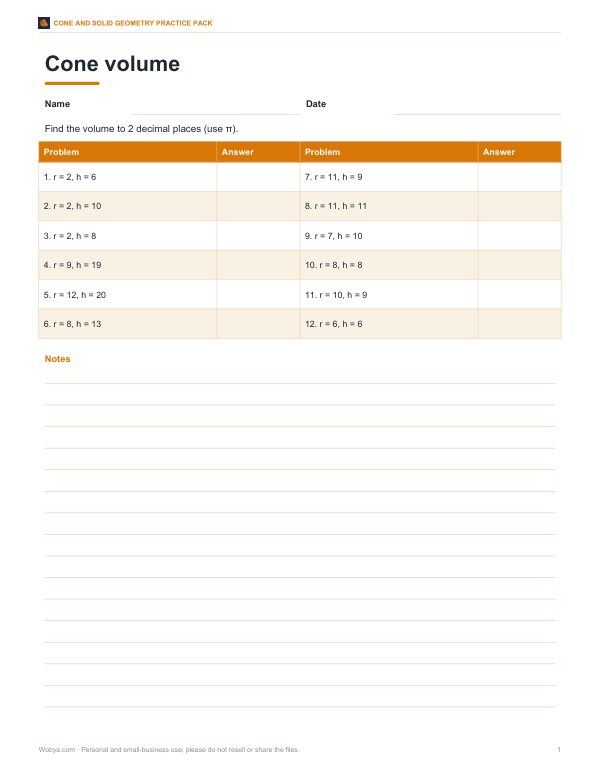
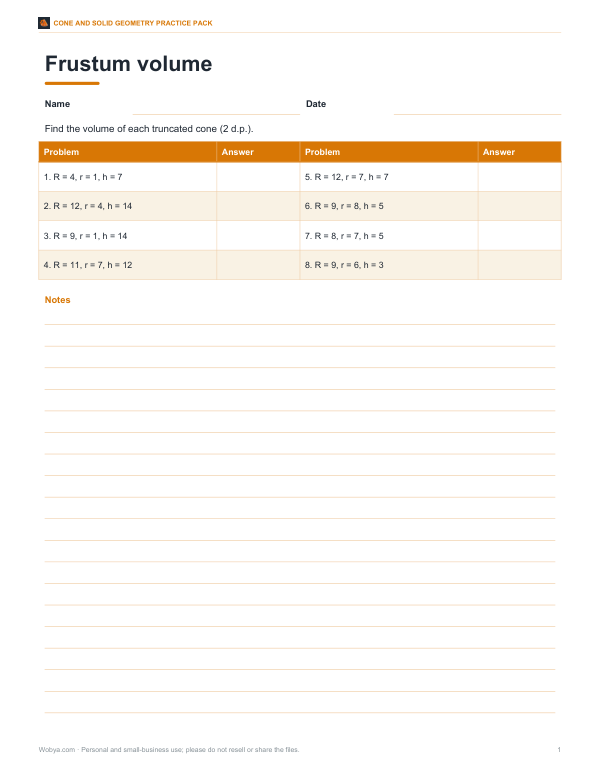
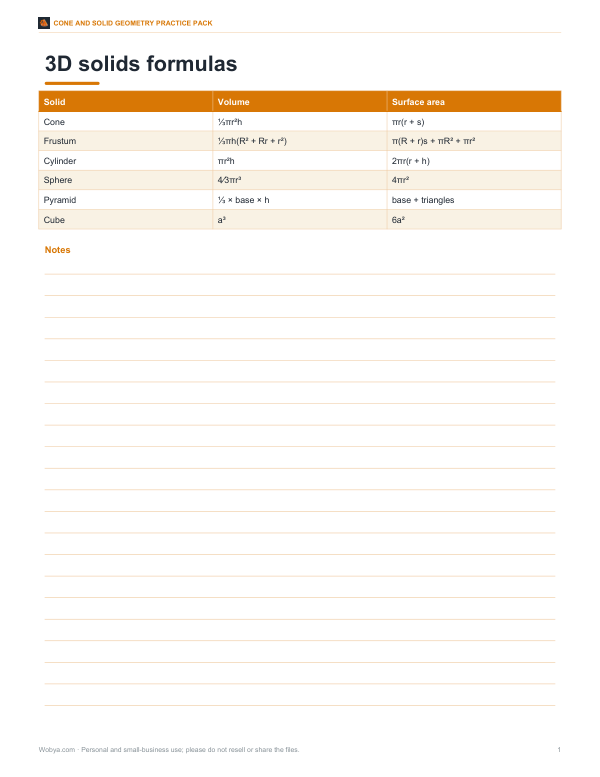
12 cone-volume questions and 8 frustum-volume questions with answer keys, a solids formula card and a cone net. All 4 PDFs are free individually; the $3 ZIP adds editable Word versions of the two worksheets.
- Cone volume: 12 questions and answers (PDF/DOCX)
- Frustum volume: 8 questions and answers (PDF/DOCX)
- Volume and surface area formula card (PDF)
- Cone net cut-out template (PDF)
Formats: PDF, DOCX. Instant download after payment (link valid 72 hours, up to 5 downloads). AI-assisted: the templates were drafted with AI help and reviewed and laid out before publishing.
$3.00 USD, one-time 6 resource files + README (7 files total)
- Instant download
- 7-day refund
- Secure checkout by Stripe
7-day money-back guarantee. Full refund within 7 days of purchase, even after you download.
Free sample: Cone Net Template (PDF, 97 KB)
Full refund within 7 days — see the refund policy and license.
Free printables
Single sheets you can print right now, no sign-up. The full pack adds every sheet in one download plus the editable files.
 Printable Cone Net Template
Cone calculator formulas
Use the same length unit for all lengths; when volume is known, use the matching cubic unit, such as cm with cm³ or ft with ft³. Radius from volume and height from slant are manual formulas, not input modes. Slant height must be converted to vertical height before entry.
| Goal | Inputs | Formula | Result unit |
|---|---|---|---|
| Cone volume | r, h | V = ⅓πr²h | cubic unit |
| Using diameter | d, h | r = d/2; V = ⅓πr²h | cubic unit |
| Height from volume | r, V | h = 3V ÷ (πr²) | length unit |
| Radius from volume (manual) | h, V | r = √(3V ÷ (πh)) | length unit |
| Slant height | r, h | s = √(r² + h²) | length unit |
| Height from slant (manual) | r, s | h = √(s² − r²) | length unit |
| Lateral area | r, s | A = πrs | square unit |
| Total surface area | r, s | A = πr(s + r) | square unit |
| Frustum volume | R, r, h | V = ⅓πh(R² + Rr + r²) | cubic unit |
| Pile volume | base diameter D, angle θ from horizontal | r = D/2; h = r tan θ; V = ⅓πr²h | cubic unit |
Cone formulas
| Quantity | Formula |
|---|---|
| Volume | V = ⅓πr²h |
| Slant height | s = √(r² + h²) |
| Lateral (curved) surface area | πrs |
| Total surface area | πrs + πr² = πr(s + r) |
| Height from volume | h = 3V ÷ (πr²) |
| Radius from volume | r = √(3V ÷ (πh)) |
| Frustum volume | V = ⅓πh(R² + Rr + r²) |
| Frustum lateral area | π(R + r)·s, where s = √(h² + (R − r)²) |
A cone’s volume is exactly one third of a cylinder with the same base and height — Archimedes’ result, which you can check by filling a cone with water and pouring it into the matching cylinder three times.
Worked example
A cone has radius 3 cm and height 8 cm. Volume = ⅓ × π × 3² × 8 = 24π ≈ 75.40 cm³, about 0.075 litres. The slant height is √(9 + 64) = √73 ≈ 8.544 cm, so the curved surface is π × 3 × 8.544 ≈ 80.53 cm² and the total surface, including the base, ≈ 108.80 cm². These are the calculator’s default values.
Piles of sand, gravel and grain
Loose material poured onto the ground forms a cone whose side slope is its angle of repose — often around 30–40° for dry sand and gravel. If you know the pile’s base diameter and the angle, the height is radius × tan(angle), and the volume follows. For example, a gravel pile 3 m across at 34° is about 1.5 × tan 34° ≈ 1.01 m high, with a volume of about 2.4 m³. Use the “Pile” mode, or measure the height directly if you can.
Everyday cones
| Object | Typical shape | Tip |
|---|---|---|
| Ice-cream cone | Cone | Measure inside radius and depth |
| Funnel | Frustum + tube | Use frustum mode for the cone part |
| Paper cup | Frustum | Top and bottom radius plus height |
| Traffic cone | Frustum | Often has a flat top |
| Hopper or silo bottom | Inverted frustum | Add a cylinder for the upper part |
| Lampshade | Frustum (surface area) | Use lateral area for fabric |
Unit conversions
- 1 litre = 1,000 cm³ = 1 dm³.
- 1 US gallon ≈ 3.785 litres ≈ 231 in³.
- 1 ft³ ≈ 28.317 litres ≈ 7.48 US gallons.
- 1 cubic yard = 27 ft³ ≈ 0.765 m³.
- Always use the same unit for radius and height before calculating.
Deriving the formula
Slice a cone into thin horizontal discs. At a distance y below the apex, the disc’s radius grows in proportion: r·y/h, so its area is π(r·y/h)². Adding up all the discs from the apex to the base — integrating from 0 to h — gives π r²/h² × h³/3 = ⅓πr²h. The same idea explains why any pyramid, whatever the shape of its base, has volume ⅓ × base area × height: the cross-sections all shrink in the same proportion towards the apex.
Cones in the kitchen and garden
| Question | How to use the calculator |
|---|---|
| How much batter fills a cone-shaped mould? | Measure the inside radius and depth; the result in cm³ equals millilitres |
| How much soil in a conical planter? | Use frustum mode with the top and bottom radii |
| How big is my compost pile? | Use pile mode with the base diameter and height |
| How much popcorn fits in a paper cone? | Cone mode with the top radius and depth |
| How much fabric for a lampshade? | Use the lateral surface area of the frustum, plus seam allowance |
Cones and angles
The apex half-angle — the angle between the axis and the side — is tan⁻¹(r ÷ h). Cones used as funnels often have a 60° apex angle (30° half-angle); a traffic cone is much narrower. The calculator reports the half-angle and the side slope measured from the base, which is the same angle as a pile’s angle of repose.
Similar cones
If you scale a cone by a factor k — doubling every length, for example — its surface area scales by k² and its volume by k³. A cone twice as tall and twice as wide holds eight times as much. That’s why a small increase in the height of a gravel or grain pile adds a surprising amount of material, and why half-filling a conical glass by height fills it only one eighth by volume.
Common mistakes
- Using the diameter instead of the radius — divide the diameter by 2.
- Using the slant height as the vertical height.
- Forgetting the ⅓ — that gives a cylinder’s volume.
- Mixing units, such as a radius in inches and a height in feet.
Privacy
All calculations run in your browser.
Frequently asked questions
How do I calculate volume of a cone with slant height?
Use the slant height only after converting it to vertical height: h = √(s² − r²). Then calculate V = ⅓πr²h. This works when s is the side length from rim to apex.
Can a cone volume calculator use diameter instead of radius?
Yes. Enter diameter in its own field; it takes priority over radius when both are filled. The calculator divides it by 2 before applying V = πr²h/3.
What units should I use for a cone volume calculator?
Use one length unit for radius, diameter, height, and slant height. The volume will be in the matching cubic unit, such as in³, ft³, cm³, or m³.
What is the formula for the volume of a cone?
V = ⅓πr²h.
How do I find the slant height?
s = √(r² + h²).
What is a frustum?
A cone with its top cut off parallel to the base.
How do I find the height from the volume?
h = 3V ÷ (πr²).
Why is a cone one third of a cylinder?
It’s a result from geometry (and calculus); you can demonstrate it by pouring water.
Can I calculate a sand pile?
Yes. Choose pile mode, enter a base radius or diameter, and leave height and known volume blank to use the angle of repose (greater than 0° and less than 90°).
How full is a cone filled halfway up?
Only one eighth of its volume, because volume scales with the cube of the height.
How many litres in a cubic foot?
About 28.3 litres.
What is the lateral area of a cone?
πrs — the curved surface only, without the base.
Can I solve for the radius?
The formula is r = √(3V ÷ (πh)), but this tool has no radius-solving input mode. Calculate radius separately, then enter it here. The known-volume field solves for height.
Does it work for an upside-down cone?
Yes — orientation doesn’t change the volume.